
SuperSlow vs traditional strength training.
If your goal is measurable strength and joint-friendly progress with the smallest weekly time commitment, SuperSlow is the better fit for most adults. If you see your time at the gym as a social opportunity, then traditional training will allow for more engagement. Below: how the two compare on safety, time, results, and cost, with citations.
- ✔ SuperSlow: 30 minutes once a week, supervised, low joint impact, measurable weekly progress.
- ✔ Traditional: 60 to 90 minutes, 3 to 5 times a week, higher peak forces, broader movement variety.
- ✔ For adults seeking strength and longevity, SuperSlow delivers comparable or better gains in roughly one-tenth of the weekly time.
The two methods, compared.
| Dimension | SuperSlow | Traditional Strength Training |
|---|---|---|
| Time per week | 30 minutes, one session | 3 to 5 sessions of 60 to 90 minutes |
| Tempo | ~10 seconds up, ~10 seconds down | 1 to 2 seconds per rep, often faster |
| Supervision | Trainer present every rep | Self-directed or occasional coaching |
| Joint impact | Very low, peak force minimized | Moderate to high, momentum spikes load |
| Cardio benefit | High, sustained heart-rate elevation | Variable, depends on rest intervals |
| Equipment | Matrix and MedX machines | Free weights, machines, mixed |
| Cost per week | $50 session + $49/mo facility (~$56/wk) | $30 to $80 gym, often plus PT fees |
| Ideal for | Busy adults, seniors, post-PT, longevity | Powerlifters, sport-specific work |
Pros
- Low joint impact, suitable for clients with arthritis or past injury
- Measurable strength gains in 6 to 8 weeks, tracked weekly
- One 30-minute appointment per week, easy to maintain for life
- Trainer corrects form on every rep, very low injury risk
- Builds bone density, supported by NIH-cited research on resistance training
Cons
- Limited movement variety compared to a full free-weight program
- Requires a studio with the right machines, not a home workout
Pros
- Wide variety of movements and equipment
- Compatible with sport-specific programming
- Available at any commercial gym
Cons
- Higher peak joint forces from momentum and acceleration
- 3 to 5 hours per week minimum for meaningful progress
- Faster movement speed increases force, the leading cause of gym injury
- Recovery demand can interfere with the rest of life
Pick by goal, not by tradition.
One of the biggest weight room misconceptions, fast repetitions build faster muscles. Fast twitch muscle fibers simply fatigue quickly, yet move at the same rate of speed as slow twitch fibers. Technically, both fiber types are either on or off, and it is the total number of fibers activated that determines movement speed at the joint. Any physical activity that can be maintained for long duration is using slow twitch (slow fatigue) fibers. Interestingly, fast twitch fibers are only activated when the muscular demand exceeds the ability of the slow twitch fibers. Therefore, it does not matter whether you reach the muscles fatigue threshold by moving fast or slow, you just introduce unnecessary force and injury when you move fast. The Mayo Clinic guide to strength training notes that the goal is muscular fatigue, not arbitrary rep counts, which is the entire premise of slow-tempo work.
Pick SuperSlow if:
- You want measurable strength gains with minimal time investment
- You have joint pain, past injuries, or osteoporosis concerns
- You want consistent progress without missing time from gym injuries
- You are returning to exercise after a long break
Pick traditional strength training if:
- You enjoy variety and exploring different lifts
- You are a competitive powerlifter
- You like the social aspect of spending several hours a week in the gym
Fact-check it yourself.
- WebMD on slow-tempo strength training
- Effects of slow speed resistance training on muscle strength
- Mayo Clinic strength training guidelines
- NIH: exercise for bone health
SuperSlow as a named protocol traces back to Ken Hutchins, who developed the method while running an osteoporosis study in the early 1980s. Bonnie & Falcon Christopher founded E Studio in 2005 to bring the method to Santa Rosa. Twenty-one years later, our injury rate on the floor remains effectively zero.
Comparison FAQ.
If your question is not here, reach out, we answer every email personally.
Book your free session →Is SuperSlow as effective as traditional strength training?
Will I lose strength if I only train once a week?
Is traditional lifting bad for my joints?
Who should still pick traditional strength training?
Can beginners do SuperSlow Strength Training?
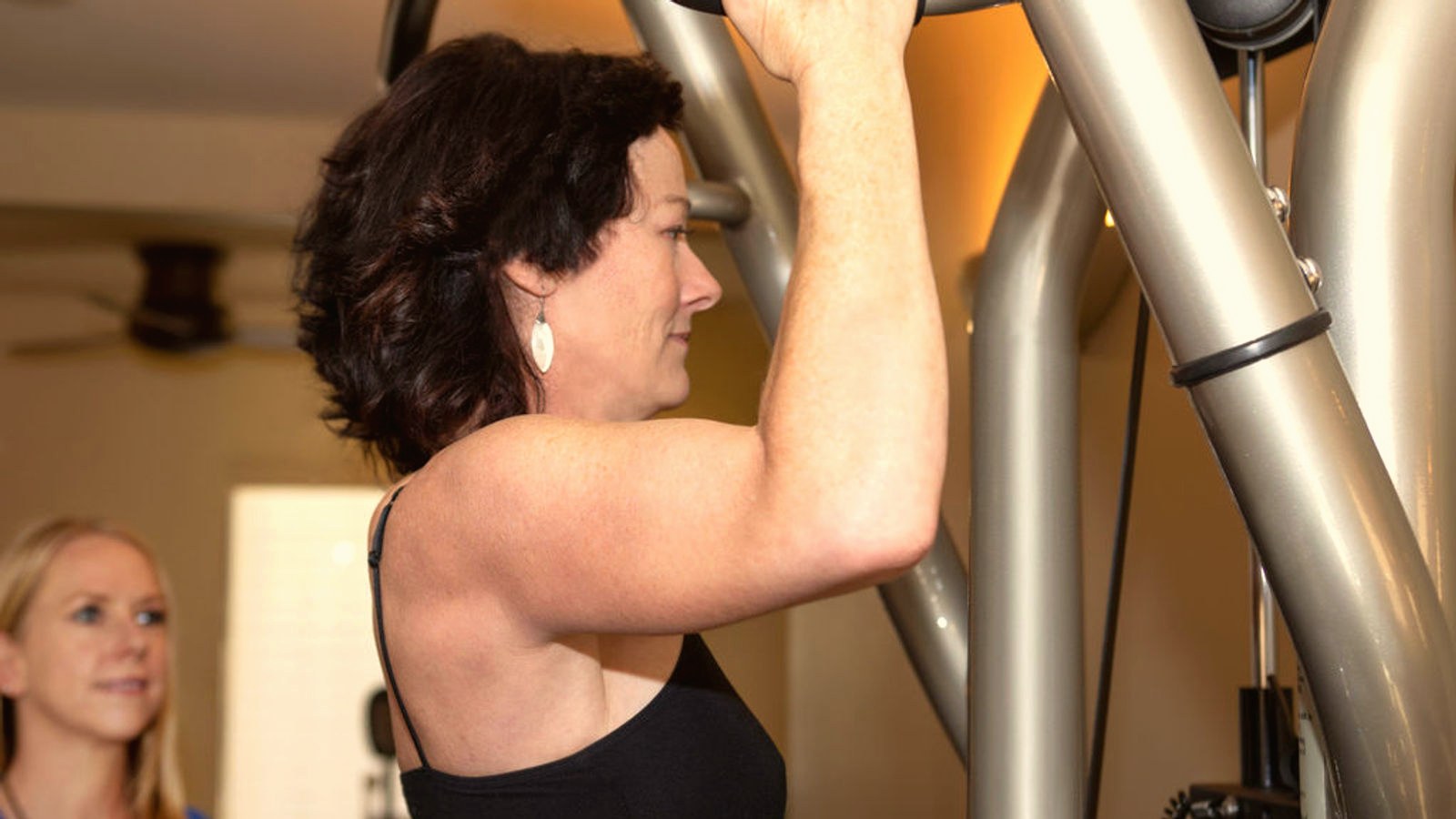
Try the method once,
return for life.
Meet your trainer, discuss your goals, review your history, and perform the SuperSlow method. No obligation to book a second session, unless you feel we are the right fit for you.
Book your free session →